Convert to PDF, Development Tips, How To, Information, Tip & Tricks

Merging PDF Files in Navision

Many of time we have multiple files in pdf but for some certain reasons we require to merge them to single File.

Continuing from my previous post i am extending my functionality with Merging of Mulitiple pdf files to single pdf file.

PDFConvMerge-2-2

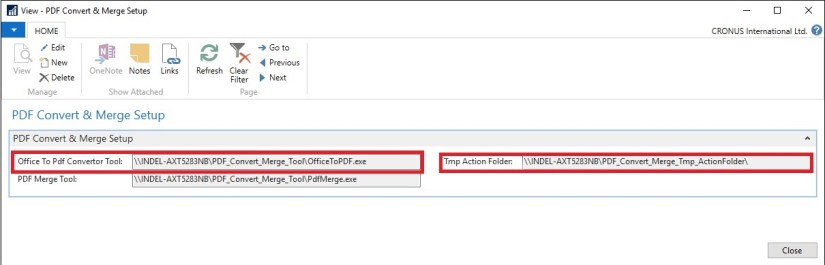
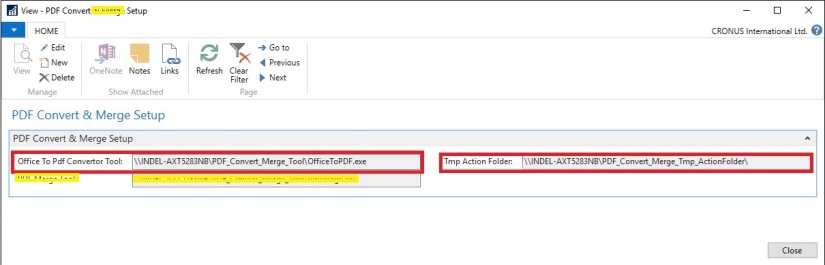
In my Setup Page created in previous post i have added one more field to store the Tool Path & File Name for Merging multiple files.

Based on the dll provided by http://www.pdfsharp.net this post is written.

Visit the Site download the utility and extract the dll file and exe file from the zip and store in same Folder.

The format of command to merge the files at command prompt is similar to:

Command to merge :- pdfmerge output=.\ActionFolder\result.pdf input=.\ActionFolder\1.pdf,.\ActionFolder\2.pdf,.\ActionFolder\3.pdf

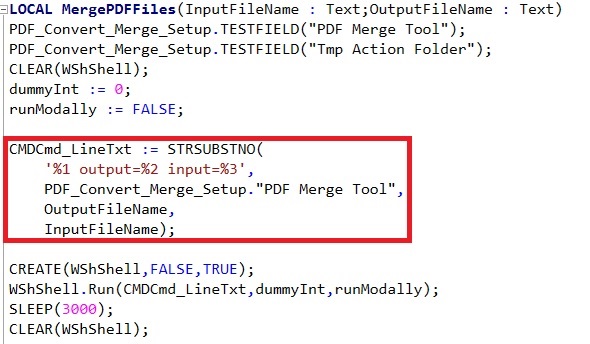
We will prepare the Function which will take as parameter the Output & Input File and run the utility to Merge these files to single file using WsShell in Navision.

PDFConvMerge-4

Function is very simple to accept the Input & Output File Names and Prepare Single PDF file from multiple pdf files provided as input (comma seperated List of Files) to the function.

To keep it simple no additional codes for test and other routine job is not added. Now you are familiar with the functionality you can tweak the code accordingly to meet all other requirements.

Thats all for this post. Will comeup with more Information in my upcoming posts.

Till then keep exploring and learning.


Convert to PDF, Development Tips, How To, Information, Office Integration, Tip & Tricks, Word

Converting Office Files into PDF from Navision

Today in this post i will walkthrough how we can convert any MS Office File into PDF.

It have been many time required to convert any attached file with the record in Navision to PDF format.

To perform this action we will require a tool which can be downloaded from:

OfficeToPDF download link :- http://officetopdf.codeplex.com/releases/view/118190

Extract and save the OfficeToPDF.exe file to some Folder.

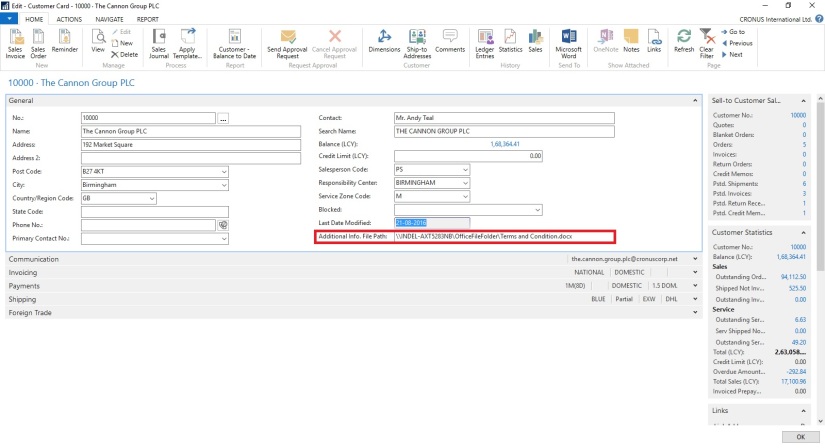
For this Walkthrough i have created a Field in Customer Table to save the File Path of the Office File which we want to convert into PDF.

PDFConvMerge-1

You can add Dialog box to select the File from the specified Folder.

For this demo i have kept it simple Text Field where you can add your File Path and Office File Name. It is assumed that only Office File will be attached here.

For Setup purpose i have created one Setup Table & Page where we will store our other required Folder paths.

PDFConvMerge-2

Here we have given provision to save the Path of the Office to PDF Convertor Tool file Path & Temporay working Folder.

I have used the shared folder for all the paths so that it is not system specific, also make sure you give required permission on this folder for all the operating accounts.

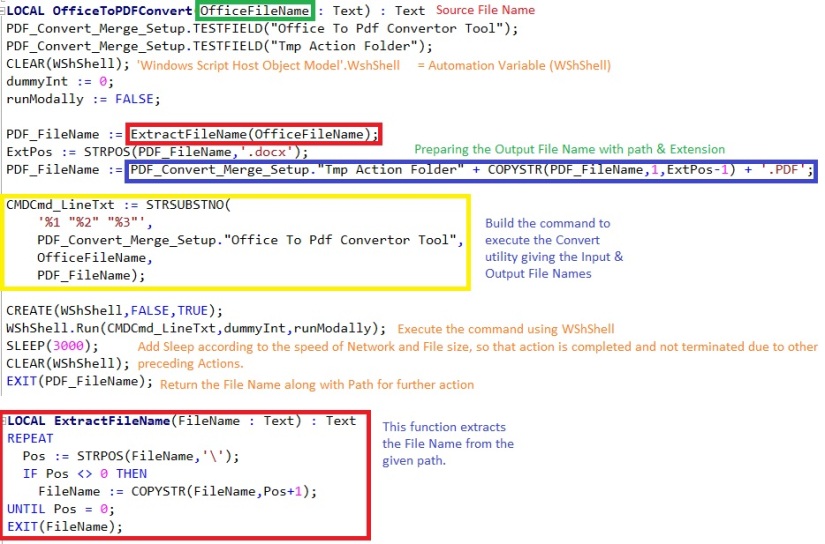
Now our Next task will be to write a function which will perform this conversion part.

PDFConvMerge-3

Above Function Takes the File Name from the Customer Card we stored above on Customer Card. Takes the Path of the Office To PDF Convertor Utility and Tmp working Folder.

Prepares the PDF file Name along with Path stored in Setup.

Prepares the command to invoke Convert Utility using WsShell and returns the PDF file File Name along with path as defined in the Setup.

Now you can use this File for futher purpose as required.

To keep it simple no additional code of test and other required routine task is not added.

Now you know the Logic you can tweak the functionality as per your requirement.

I will comeup with more information in my up comming posts, till then keep exploring and learning.


Corfu Navision 2016, Development Tips, How To, Information, Report, Tip & Tricks

Controlling User wise Report Print & Save As… Permission


It is always asked from several users to have a control on Printing of reports from Preview.

Normally you have two options to print the Report in Navision.

  • From Request Page

PrintPreview1

  • From Print Preview

PrintPreview2

If you check document Reports you will notice that you don’t have option to Print the Report from Preview, but you can print from Request Page.

Why it doesn’t allow in such Reports?

It is because these report uses statement like:

IF NOT CurrReport.PREVIEW THEN

If the C/AL code for the report uses the PREVIEW function to disable printing from the preview, then users cannot change the display mode to print layout.

Using these option I have tried to disable Printing of Report from Request Page and Print Preview.

PrintPreview3


Add a Boolean type Field in User Setup Table & Page as shown above.

Now the report which we want to restrict from printing we will add piece of code.

Although there are other ways to do this but to keep it simple I have followed this approach. Once you are ok with logic you can implement the same in your way, in fact more better way than this sample demo.

PrintPreview4

If I run the report by setting Allow Report Printing to FALSE, it will not show me the Print & Save as Option on Preview.

PrintPreview5

Also if I Try to Print or Save As… from Request Page it will Flag me an error as above.

So now you know the logic behind it, what you are waiting for. Give your user to control the Printing & Save As… option.

Now in last Cumulative Updates also Microsoft added option to control this,  but it is at Service Level, if you want to control at user Level this is one option, wait for any further Cumulative Update in which Microsoft may add this capability or explore and find any other option and share with others.

That’s all for this post. I will come up with more details in my upcoming posts.

Till then keep exploring & learning.


Data, Development Tips, How To, Information, PowerBI.com, Tip & Tricks

App for Power BI REST APIs for Streaming Data

In this post we will see how to create app to use the Power BI REST APIs for Streaming Data.

Full documentation: https://powerbi.microsoft.com/documentation/powerbi-service-real-time-streaming/

To run this app follow the steps discussed in my previous post: [Real-Time Dashboard Tile & Streaming Dataset– in Power BI]

Summary as below:

  1. Go to app.powerbi.com
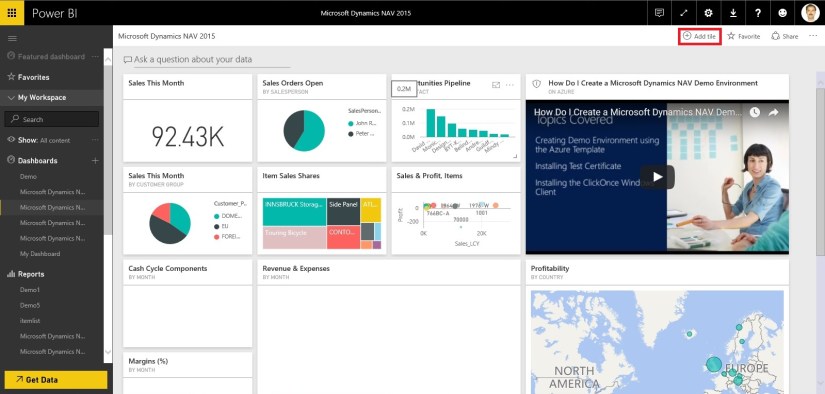
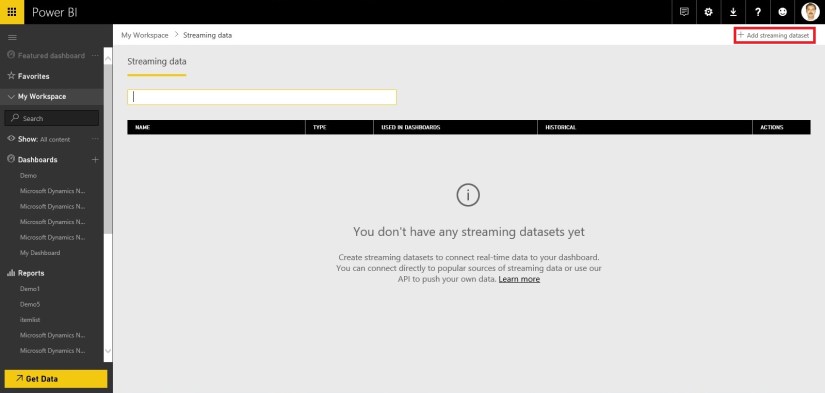
  2. Go to streaming data management page by via new dashboard > Add tile > Custom Streaming Data > manage data
  3. Click “Add streaming dataset”
  4. Select API, then Next, and give your streaming dataset a name
  5. Add a field with name “Customer ID”, type Number
  6. Add a field with name “Customer Name”, type Text
  7. Add a field with name “Sales Value”, type Number
  8. Click “Create”
  9. Copy the “push URL” and paste it as the value of “realTimePushURL” in below app

We will start with new project in Visual Studio.

RealTimeSync-12

Create a new Visual C# Console Application.

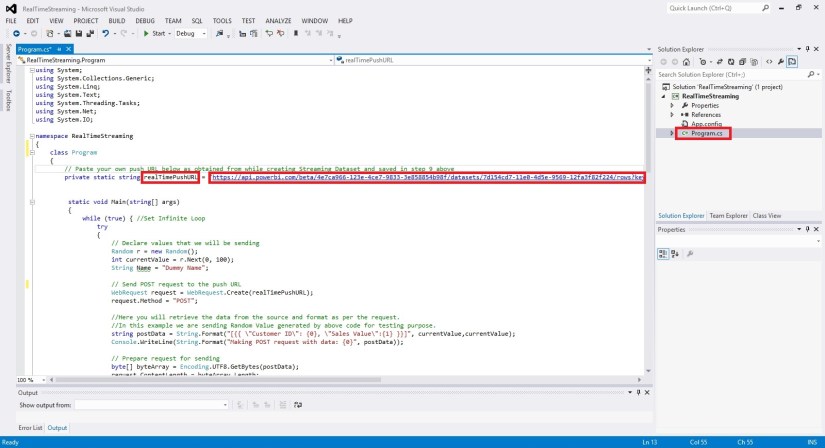
Open the Program.cs File and write a code as shown below.

This app Uses the WebRequest sample code as documented here: https://msdn.microsoft.com/en-us/library/debx8sh9(v=vs.110).aspx

RealTimeSync-13

For your easy here is the code of Program.cs below:


using System;

using System.Collections.Generic;

using System.Linq;

using System.Text;

using System.Threading.Tasks;

using System.Net;

using System.IO;


namespace RealTimeStreaming

{

class Program

{

// Paste your own push URL below as obtained from while creating Streaming Dataset and saved in step 9 above

private static string realTimePushURL = “https://api.powerbi.com/beta/4e7ca966-123e-4ce7-9833-3e858854b98f/datasets/7d154cd7-11e0-4d5e-9569-12fa3f82f224/rows?key=mD1nkJOf426PjPPaEQsW9xEg%2FN1EENQ2hRZvXIpHr%2BTXNk3XQpKsR2Jbe5CATiMoLmxjlzSp%2FIMlbe9HL8G4xQ%3D%3D”;

static void Main(string[] args)

{

while (true) { //Set Infinite Loop

try

{

// Declare values that we will be sending

Random r = new Random();

int currentValue = r.Next(0, 100);

String Name = “Dummy Name”;

// Send POST request to the push URL

WebRequest request = WebRequest.Create(realTimePushURL);

request.Method = “POST”;


//Here you will retrieve the data from the source and format as per the request.

//In this example we are sending Random Value generated by above code for testing purpose.

string postData = String.Format(“[{{ \”Customer ID\”: {0}, \”Sales Value\”:{1} }}]”, currentValue,currentValue);

Console.WriteLine(String.Format(“Making POST request with data: {0}”, postData));


// Prepare request for sending

byte[] byteArray = Encoding.UTF8.GetBytes(postData);

request.ContentLength = byteArray.Length;

// Get the request stream.

Stream dataStream = request.GetRequestStream();

// Write the data to the request stream.

dataStream.Write(byteArray, 0, byteArray.Length);

// Close the Stream object.

dataStream.Close();

// Get the response.

WebResponse response = request.GetResponse();

// Display the status.

Console.WriteLine(String.Format(“Service response: {0}”, ((HttpWebResponse)response).StatusCode));

// Get the stream containing content returned by the server.

dataStream = response.GetResponseStream();

// Open the stream using a StreamReader for easy access.

StreamReader reader = new StreamReader(dataStream);

// Read the content.

string responseFromServer = reader.ReadToEnd();

// Display the content.

Console.WriteLine(responseFromServer);

// Clean up the streams.

reader.Close();

dataStream.Close();

response.Close();

}

catch (Exception ex)

{

Console.WriteLine(ex);

}

// Wait 5 second before sending

System.Threading.Thread.Sleep(5000);

} //Infinite Loop ends here.

}

}

}

Compile and Run the Program.

RealTimeSync-14

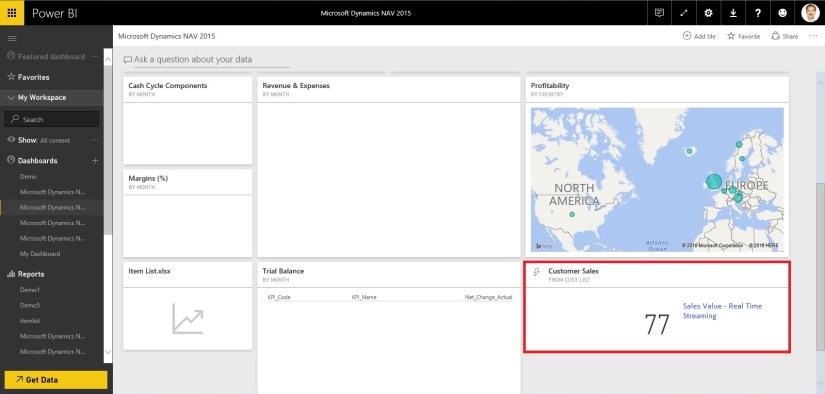
Leave the Program Running and switch to Power BI dashboard. You will see your newly created Tile in previous post will be displaying the Random Value generated by this program updating every 5 seconds.

That’s all with little tweaking to this program you can fetch your data and send the updated data to your Real Time Streaming Dataset.

That’s end to this post.

I will come up with more details in my upcoming posts.

Till then keep Exploring and learning.


Data, Data Model, Development Tips, How To, Information, PowerBI.com, Tip & Tricks

Real-Time Dashboard Tile & Streaming Dataset– in Power BI

Power BI have introduced real-time dashboard tiles – a lightweight, simple way to get real-time data onto your dashboard. Real-time tiles can be created in minutes by pushing data to the Power BI REST APIs or from streams you’ve created in Azure Stream Analytics or PubNub, a popular real-time streaming service. Let’s see how we can do in no time.

Login to your Power BI using your credentials.

Go to your dashboard where you wish to add Real Time Streaming Tile, choose “Add a tile”

RealTimeSync-1

Select the “Custom streaming data” option

RealTimeSync-2

Click on Next.

RealTimeSync-3

At first usage you may not be having Streaming Dataset, if you have List will be shown.

Let’s create one for our Example, Click the link – Manage Data.

RealTimeSync-4

Click on Add Streaming Dataset.

RealTimeSync-5

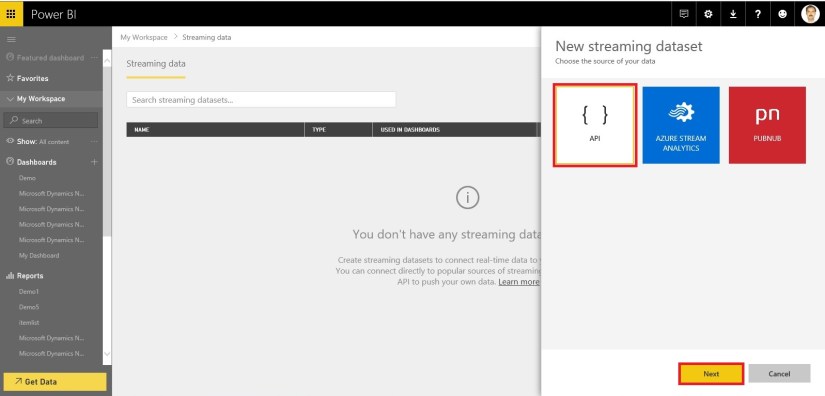
From New Streaming Dataset, Select API and click on Next.

RealTimeSync-6

Add your Dataset Name, Fields and Datatypes.

Once you are done, Click on Create.

RealTimeSync-7

Copy your Push URL, we will require this to push data to Data Stream.

Click On Done.

RealTimeSync-8

Returning to our Previous Step, Now we can see Streaming Dataset Available.

Select your Dataset and Click on Next.

RealTimeSync-9

Select the Type of Visualization you want, and Fields to display.

Click on Next.

RealTimeSync-10

Give Title, Subtitle to your Tile and click on Apply.

RealTimeSync-11

Bravo, you are done, your Tile will be added on your Dashboard.

But hold on, the Value will not come until you add logic to push data to the Tile.

Now we will move to our Next Step, where we will create a program to call Power BI REST API and push Streaming data to our Dashboard. Checkout my next post for same. [App for Power BI REST APIs for Streaming Data]

Till then keep Exploring & Learning. I will return soon with my next post.


Data, Development Tips, How To, Information, Tip & Tricks

Creating Views – to Save Filtered Lists in NAV

Do you Know you can save the Page as View with filters.

Many of time we access to Page and apply same set of Filters to fetch our data. You can save the same for quick retrival of data applying the filters automatically in future access.

You save the Page with Filters as View.

Let us see small example how to achieve it.

First we will open the List Page in my case i am having one customized Customer List.

FilteredView-1

Suppose this is the Page which i use for Balances Retrival each month and on daily basis.

I Enter Filter as Balance > 5000 & Current Month Filter whenever i wish to check balances for my reporting or followup purpose.

For Date Filter i use (-CM..CM) sothat when i open this view next month it takes the appropriate Filter for that month.

FilteredView-2

Click on the Page Name post applying all the required Filters.

Select Save View as.

Give the Name for the View.

Select the Location to save the View.

On Confirmation respond as Yes.

FilteredView-3

Your View will be Saved, You can create as much Views as desired using different Filters.

FilteredView-4

Small and good Feature.

What you are waiting for give it a try.

I will comeup with more information in my upcoming posts, till then keep exploring and learning.


Alert, Development Tips, How To, Information, PowerBI.com, Tip & Tricks

Working with Alerts in Power BI

Knowing about changes to important metrics quickly some time can help you taking quick decisions or help you keep eyes on things you care most.

With data driven alerts in Power BI, you can now get notifications when a metric you care about on your dashboard exceeds a set threshold.

Alert notifications will be sent to you as an email, and appear in your notification center on the web and in mobile apps.

You can set alerts for your numeric tiles featuring cards and gauges only. You have control over how often you want to be notified about your data, and whether you want to receive an email when your data goes beyond the limits you set.

Only you can see the alerts you set, even if you share your dashboard.

Alerts only work on data that is refreshed. When data refreshes, Power BI looks to see if an alert is set for that data. If the data has reached an alert threshold, an alert is triggered.

Alerts only work with numeric data types.

Alerts only work on data that is refreshed. They do not work on static data.

Today we will see how to work with Alert feature in Power BI.

Login to your Power BI using your credentials.

Switch to your Dashboard.

I have one ready to use dashboard from my previous post to show Alert feature I am using the same.

As discussed above it works only for Numeric & Gauges Tiles only, for others you will not get even the Alert option.

Luckily I have one on my Dashboard, if want to learn how to create Numeric Tiles or more details on working with Power BI you can refer to any of my previous posts on Power BI. However you can find here one direct Link to the topic in question.

You see I have selected my Numeric Tile in below screen shot.

DataAlert-1

How to Set Data Alerts:

From a dashboard tile, select the ellipses.

Select the bell icon  to add one or more alerts.

DataAlert-2

Click on Add Alert Rule.

To start, ensure the Active slider is set to ON, and give your alert a title.

DataAlert-3


Set your Condition, Threshold, and Notification Frequency also don’t forget to tick on send me mail too.

Click on Save to save your Alert.


Receiving alerts:

When the data being tracked reaches one of the thresholds you’ve set, several things will happen.

Power BI checks to see if time have lapsed or more than depending on the option you selected since the last alert was sent.

As long as the data is past the threshold, you’ll get an alert every hour or every 24 hours depending on option you selected.

If you’ve set the alert to send you an email, you’ll find something like as shown in below screen, this in your Inbox.


DataAlert-4


Power BI will add a message to your Notification center and adds a new alert icon to the applicable tile as shown in below screen.

DataAlert-5


Access to your Notification.

DataAlert-6


Manage alerts:

There are three ways to manage your alerts:

From the dashboard tile

From the Power BI Settings menu

On an individual tile in the Mobile App

DataAlert-7


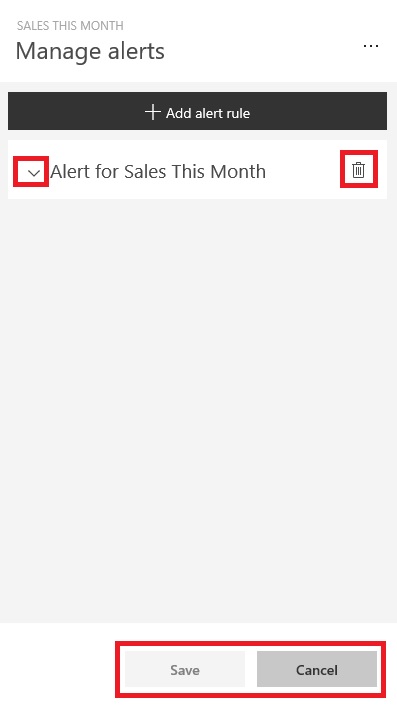
As we have seen above how to create Alerts follow same steps to access Alert Window.

At the Left click on Expand make Necessary Modifications and save.

At the right select the trashcan to delete the Alert.

Select cancel to return to previous window.


DataAlert-8

From here you can turn alerts on and off, open the Manage alerts window to make changes, or delete the alert.


That’s all for today.

I will come up with more details in my upcoming posts.

Till then keep exploring and learning.


Development Tips, How To, Information, Instalation & Configuration, Jet Reports, Office Integration, Report, Tip & Tricks, What's New

Jet Professional 2017 – Introduction and Installation

Why to switch to and What’s New in Jet Professional 2017?

Its valid question same came to my mind also when i heard about new Release.

Then i tried to explore a bit about it and got an information about some exciting features introduced with it. I will discuss as i progress with my evaluation and exploration with these features.

Here i am giving bit overview about some features and limit to Installation topic in this post. If you wish to know more you will have to wait for my next few upcomming posts.

As per Jet Report Sources:

Jet Professional 2017 makes sharing your reports easier than ever before!  

Reporting with (and without) the Jet add-in for Excel

The Jet Web Portal is an online interface that provides an easy-to-manage repository for your organization’s reports.

Using the web interface and Office 365 Online, you can allow any of your network users – whether they have Excel and the Jet add-in installed or not – to view reports directly from their web browser.

Jet Mobile for Jet Enterprise

Jet Professional integrates with the Jet Mobile web client – allowing you to log into one site to see and run all your reports – and to see all of your business intelligence dashboards.

And… Jet Mobile for Jet Enterprise includes many new features – making your dashboards more powerful and even easier to use.

What’s New?

Publishing to the Jet Web Portal

The Jet ribbon within Excel includes the ability to publish your reports to the Jet Web Portal.  The Jet Web Portal provides a manageable repository for your organization’s reports. All your users – whether they have Excel and Jet Professional installed or not – can run and view reports directly from their web browser.

What is Jet Web Portal

Jet Professional 2017 represents a new way to manage, run and view your business reports. Designed for today’s always-connected, always-moving workforce, Jet Professional 2016 introduces a new Information Management System that allows business users access to their business reports using virtually any device through a simple web interface.

As a user, you don’t need to install anything to run and view reports. Within the Jet Web Portal, you can quickly find the report that you’re after, specify report parameters, run the report to get up-to-the-minute data and view it in Excel Online.

With features like sharing, search, version control and report permissions, Jet Professional 2017 is a complete report management system.

Will comeup with more detailed about new features in my upcomming posts.

Let us move to Installation part.

To get the installation file go to this link : https://www.jetreports.com/support/product-downloads/

After downloading you will get the Jet Professional Installation Files.Zip, extract it.

Install-1

Befor you start installation make sure no Excel instance is running on your system.

I am doing simple one system Instalation, will come up with more details and other options later.

Double click to Setup file to begin with installation.

Install-2

If you have Activation code enter it or you can continue and activate later.

Install-3

Select instalation type as desired, i am installing All Components.

Install-4

Select the features you want to install, since i am performing complete install, so i am accepting all as suggested by default.

Install-5

Select the Account to run the service, and don’t forget to select Add rules to Windows Firewall. Rest all as default suggested.

Install-6

Select the SQL Instance for Jet Service Database and login method.

Install-7

Select desired ports and host detail or accept as suggested as default.

Install-8

Enter Jet Service Tier details or accept suggested as default.

Now your pre-configuration part is completed. Click on Install to proceed with Jet Components Instalation.

Install-10

Click on Install to proceed.

Install-11

Click on Finish to exit Instalation wizard, your Jet is now installed with above provided configuration.

Install-12

Next Step is to Activate your Jet Professional.

From Jet Tab on Ribbon select Activate Jet Professional.

choose the desired option.

Install-13

Enter your activation code and click on Next.

Install-14

Copy the message and send to the mentioned e-mail id and click Next.

Install-15

Close to exit.

Wait for the Activation Token, it may take upto 24 hours to receive mail with this code.

Install-16

If you check your Start Menu you will find these components got installed.

Install-17

Once you receive your Tocken.

Launch Excel, From Jet Tab, Click on Help from ribbon and select Activate License.

Install-18

Select Enter provided Activation token.

Install-19

Copy the Token you received via mail here and click on Activate.

Install-20

If every thing is fine you will receive the Activation Successful message.

Now you are ready to start with using Jet Professional.

I will come up with more details on this in my upcomming posts till then keep exploring and learning.


Development Tips, Dynamics 365, How To, Information, Maderia, Office Integration, Power Bi Content Pack, PowerBI.com, Tip & Tricks, Troubleshooting Tips, Web Services

Working with Project “Madeira” Content Pack for Power BI

In today’s post we will see how to use Power BI Content Pack for Madeira.

The content pack is preconfigured to work with sales data and financial data from the demonstration company that you get when you sign up for the Project “Madeira” preview.

To see your Project “Madeira” data in Power BI, you must have the following:

  • Access to Project “Madeira”.
  • Access to Power BI.

Before we start with connecting we will collect few information that we will require while connecting the Power BI to fetch data from Madeira.

User Name

Web Service Acess Key

Note down both value, if you don’t have Web Service Access Key Generate one and set appropriate Expiration date or Set Never Expire as shown below.

PowerBi_Madeira-1

Next open the Web Service Page.

Make sure all selected Web Service is running as in below screen.

The data is extracted from your Project “Madeira” company using web services to read live data. In Project “Madeira”, the Web Services window lists the web services that have been set up for you, including the following that are consumed by the content pack in Power BI:

  • ItemSalesAndProfit
  • ItemSalesByCustomer
  • powerbifinance
  • SalesDashboard
  • SalesOpportunities
  • SalesOrdersBySalesPerson
  • TopCustomerOverview

Note: If you change the name of any of these web services, the data will not show up in Power BI.

Note your URL of OData. Edit it to follow the format one shown in below screen.

PowerBi_Madeira-2

Now we have all our required information.

Open Power BI site and Get Data from Services as shown in below screen.

PowerBi_Madeira-3

Select Project “Madeira” Content Pack and click on Get.

PowerBi_Madeira-4

Enter the URL of Web Service we get in above step.

PowerBi_Madeira-5

Select Next.

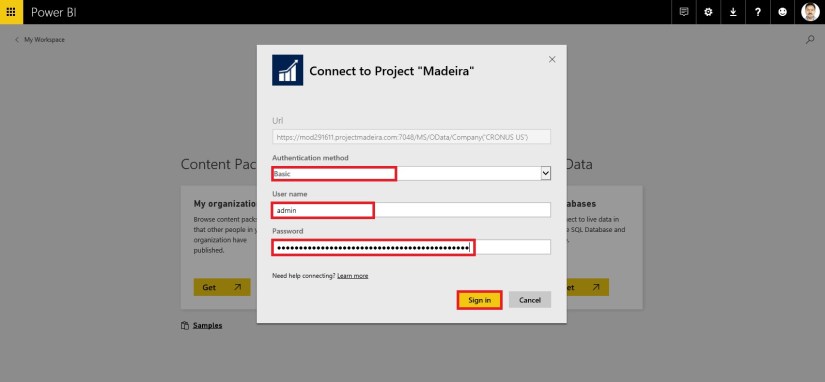
Select Authentication method as Basic.

In User Name enter your user name as obtained in above step.

For Password ented the Web Service Access Key as obtained in above step.

PowerBi_Madeira-6

Choose Sign In.

After few minutes/seconds churning you will be ready with your first Dashboard from Madeira.

PowerBi_Madeira-7

Troubleshooting

“Parameter validation failed, please make sure all parameters are valid”
If you see this error after you enter your Project “Madeira” URL, make sure the following requirements are satisfied:

“Login failed”
If you get a “login failed” error when you log in to the dashboard, using your Project “Madeira” credentials, then this can be caused by one of the following issues:

  • The account you are using does not have permissions to read the Project “Madeira” data from your account.

    Verify your user account in Project “Madeira”, and make sure that you have used the right web service access key as the password, and then try again.

  • The Project “Madeira” instance that you are trying to connect to does not have a valid SSL certificate. In this case you’ll see a more detailed error message (“unable to establish trusted SSL relationship”).

    Note: Self-signed certificates are not supported.

“Oops”
If you see an “Oops” error dialog after you pass the authentication dialog, this is most frequently caused by a problem connecting to the data for the content pack.

Thats all for today’s post.

I will comeup with more details in my upcomming posts.

Til then keep exploring and learning.
 

Development Tips, How To, Information, PowerBI.com, Tip & Tricks

Happy First Birthday to Power BI!

One year ago, on July 24, 2015, the new Power BI service was released, Power BI Desktop, and Power BI Mobile as an innovative cloud-based business intelligence solution.

At the time of the launch, Microsoft Corporate Vice President James Phillips wrote that “Power BI sets the standard for modern business intelligence”.

You can read more on :- https://powerbi.microsoft.com/en-us/blog/happy-first-birthday-to-power-bi/

I have written several posts for beginers you can find here:

In case you have missed my previous posts here I present the link to all previous posts below.

Microsoft Power BI – Part – I

Introduction to Power BI and Creating Report from Excel Data, Local Files.

Microsoft Power BI – Part – II

Introduction to few Features of Power BI

Microsoft Power BI – Part – III

Power BI Desktop, Creating Dataset & Reports from In Premise Database installation

Microsoft Power BI – Part – IV

Power BI Gateway usage

Microsoft Power BI – Part – V

Scheduling Refresh of Dataset & Report created using In Premise Database

Microsoft Power BI – Part – VI

Power BI Content Pack

Microsoft Power BI – Part – VII

Power BI Mobile App

Microsoft Power BI – Part – VIII

Power BI Content Pack

Microsoft Power BI – Part – IX

Power BI Publisher for Excel

Microsoft Power BI – Part – X

ANALYZE IN EXCEL.

Search the Blog site with PowerBI tag and you will find more posts explaing about PowerBI features and capabilities.

I will comeup with more details in my upcoming posts.

Till then keep exploring & Learning.