Functional Tips

Create a Sales Invoice for a new Customer

In this session we will create a sales invoice for a new customer (Customer we don’t have in our Master).

To follow Step by Step you need to do a small setup:

Open the User Personalization and Set your Profile ID as below:

SINewCustomer-1

Select your Profile as “SMALL BUSINESS

Your Role Center will look like below:

SINewCustomer-2

  • On the Role Center, choose Ongoing Sales Invoices to open the list of ongoing sales Invoices.
  • On the Home tab, in the New group, choose New to create a new sales invoice.
  • In the Customer Name field, type the name of the new customer, and then press Enter or Tab to leave the field

Create the sales invoice for the new customer.

Notice that some fields are marked with red asterisks to tell which fields must be filled.

SINewCustomer-3

  • In the pop-up dialog, choose Yes to create the new customer
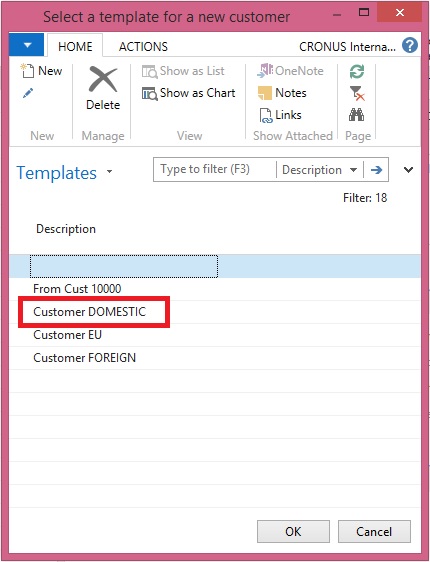
  • In the Templates window, select Customer DOMESTIC (or as desired), and then choose the OK button.

SINewCustomer-4

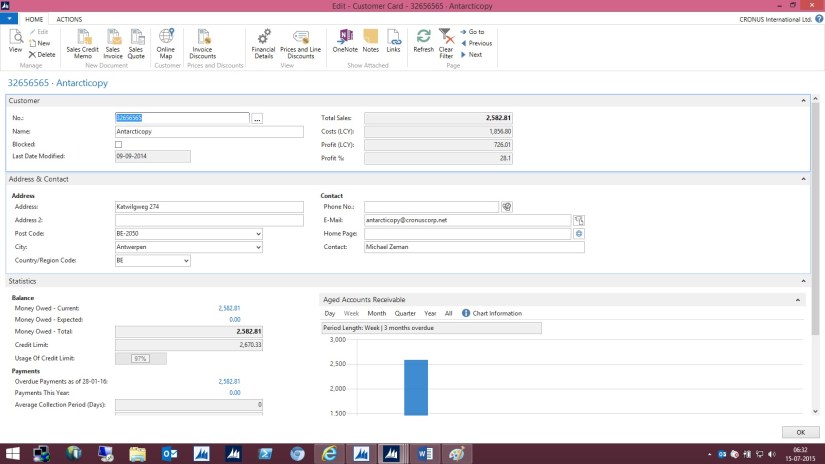
  • The Customer Card window opens in edit mode. Choose the OK button to close it.

SINewCustomer-5

  • The page closes and focus is back on the sales invoice that is now updated with the customer data.
  • In the Sales Invoice window, on the Lines FastTab, create a new line:

         Enter some line data for example : Item No.: 1001, Quantity: 10

  • On the Home tab, in the Posting group, choose Post.
  • Choose Yes.

SINewCustomer-6

  • Choose No to review the posted sales invoice, as of now we don’t require.

Helpful where we require instant Customer registration for recording the Orders. Later we will fill out rest of the details regarding Customer.

Development Tips

UpdatePropagation Property

Sets a value that specifies what happens when a main page with a subpage is updated.

The UpdatePropagation property is available on part controls and has two options; Subpage and Both.

If UpdatePropagation is set to Subpage, an update action will update the subpage only.

If UpdatePropagation is set to Both, an update action will update both the main page and the subpage.

This is useful if a value on the subpage changes, and you want a main page total to be refreshed automatically.

Use the UpdatePropagation property to update a main page total, when the amount on the subpage lines is updated. Add a CurrPage.UPDATE(); call, for example, in the OnValidate trigger on the subpage to have the UpdatePropagation property take effect.

Let’s do it practically how it works:

I am taking Sales Order for demo of above property.

Let’s start with adding a field in Sales Header Table
UpdatePropagation-1

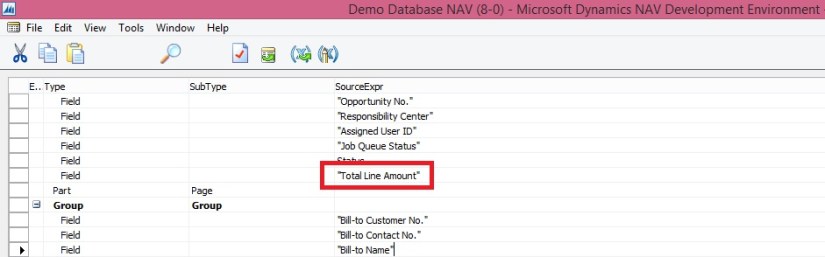
I have added Total Line Amount as Flow field to Sum Line Amount from Lines.

Next I will add this field to Sales Order Page.
UpdatePropagation-2

If we run now and make changes in Lines the Total Line amount will not update until we refresh the Page. To enable auto refresh we will be required to add Update Propagation Property of the Subpage to Both.
UpdatePropagation-3

After doing this if I make any changes which changes the Line Amount for the lines, The Total Line Amount in Header will get updated automatically, we will not require to refresh the page.
UpdatePropagation-4

We are done, so simple.

Development Tips

Data Upgrade Codeunit in Navision 2015 – Part -2

We have seen how to create Upgrade code unit in our previous post.

Please go through it, if not seen earlier the Data Upgrade Codeunit in Navision 2015 – Part -1 here 

Let us continue from where we left our previous post.

We have created the Upgrade code unit to copy the data to upgrade table while performing destructive changes to My Sales Customer table.

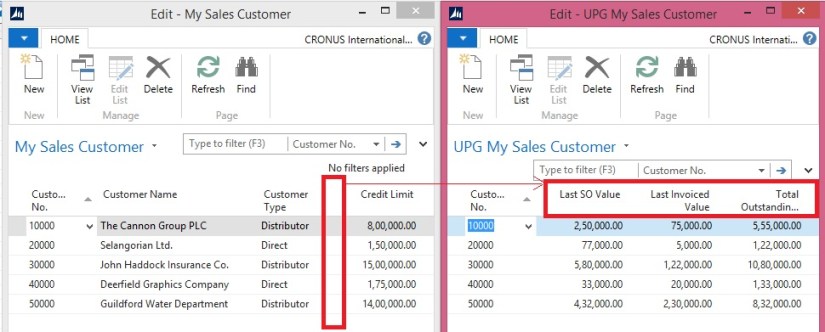
We removed certain fields from the My Sales Customer table and the related information was moved to UPG My Sales Customer table.

Now it’s time to move these information to actual table we create for this purpose My Detailed Customer Entry table.

Although in this example this table will be exact copy of UPG My Sales Customer table, so simply we need to copy records to My Detailed Customer Entry table.

But some time we may require to add certain more field’s value while moving the data Like Entry No, Posting date to maintain the data integrity. Like think of some Service type of information you are maintaining then the same set of record may repeat number of times on different dates, then in this case we will require to add certain fields like Entry No. and Posting Dates.

Let us assume we will be maintain data of My Detailed Customer Entry in incremental way as of situation on every transaction. Balances will be maintained as of when transaction was performed.

Although this example is not feasible or practice but still we are continuing to just see how to write Upgrade Function for such purpose.

Our today’s task is to design and run data upgrade function to move data from the upgrade table to its new location.

Now the fields are deleted from the My Sales Customer table and the data is saved in the UPG My Sales table. The next step is to create the new table where the data will reside (My Detailed Customer Entry) and move the data into that table.

Let’s create the table to be used for recording of all future Customer Balances and to accommodate the data we already had in the My Sales Customer table and which we moved into the UPG My Customer table.

  • In the Object Designer select the Tables button and then select New button to create a new table
  • Define the table layout based on the layout shown in the Screenshot.

Upgrade Codeunit 2 - 1

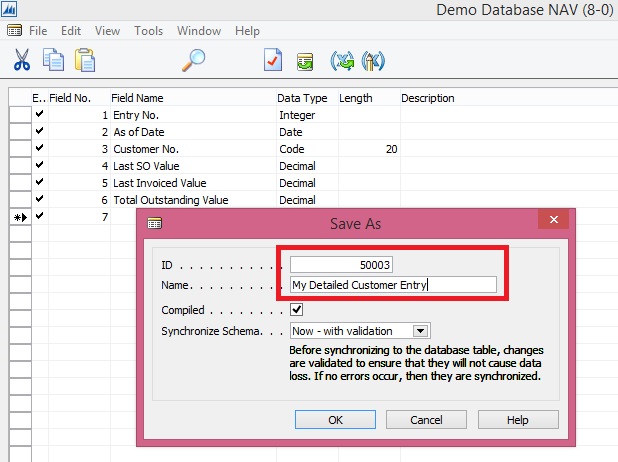
  • In the Dev. Environment menu, select File-Save action to save the table.
  • On the Save dialogue, define ID, Name = My Detailed Customer Entry, and select OK to save the table.
  • Close the table editor.

We will now create a new function which will contain the code to migrate the data from the upgrade table to the new table.

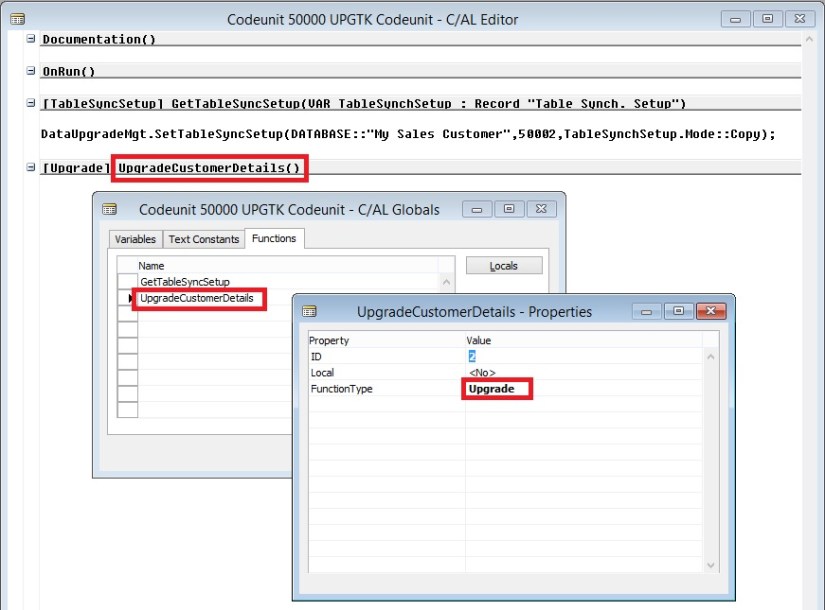
Note that the FunctionType property of the newly created function is set to “Upgrade”. This is how the NAV server can later figure out which function from the upgrade codeunit it must execute.

The function marked as “Upgrade” function can call functions marked as “Normal” if necessary.

  • In the Object Designer select the Codeunits button, select codeunit 50000 UPGTK Codeunit and then select the Design button.
  • In the Dev. Environment menu, select View-C/AL Globals action and in the form which is opened select the Functions tab.
  • Enter the name of the function, e.g. UpgradeCustomerDetails

Upgrade Codeunit 2 - 2

  • Select the UpgradeCustomerDetails function on the Functions tab and then select the Locals button to define function parameters.
  • On the C/AL Locals form, select Variables tab and add 3 local variables as shown in the Screenshot section.
  • Close the C/AL Locals and C/AL Globals forms to return to the C/AL Editor.

Upgrade Codeunit 2 - 3

The code we add to the UpgradeCustomerDetails function will copy the data from the UPG My Sales Customer table to the My Detailed Customer Entry table and then clean up the UPG Vehicle table.

  • Code like the Screenshot into the UpgradeCustomerDetails function.

//>> Upgrade Code

EntryNo := 1;

WITH UpgCustomer DO BEGIN

IF FINDSET THEN

REPEAT

DetailedCustomerEntry.INIT;

DetailedCustomerEntry.”Entry No.” := EntryNo;

DetailedCustomerEntry.”Customer No.” := “Customer No.”;

DetailedCustomerEntry.”As of Date” := today;

DetailedCustomerEntry.”Last SO Value” := “Last SO Value”;

DetailedCustomerEntry.”Last Invoiced Value” := “Last Invoiced Value”;

DetailedCustomerEntry.”Total Outstanding Value” := “Total Outstanding Value”;

DetailedCustomerEntry.INSERT;

EntryNo := EntryNo + 1;

UNTIL NEXT = 0;

DELETEALL;

END;

//<<Upgrade Code

  • In the Dev. Environment menu, select File-Save action to save the codeunit.
  • On the Save dialogue select OK button.
  • Close the codeunit editor.

Upgrade Codeunit 2 - 4

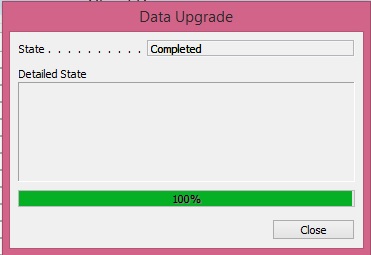
  • In the Dev. Environment menu select Tools – Data Upgrade – Start… action.
  • Agree to the confirmation dialogue.
  • In the Start Data Upgrade window select the OK button.

You can start the data upgrade process from the Dev. Environment, or from Microsoft Dynamics NAV 2015 Administration Shell, using Start-NAVDataUpgrade cmdlet.

The NAV server will locate all upgrade codeunits and will invoke all upgrade functions within these codeunits for all companies in the database.

If you have multiple upgrade functions in your upgrade codeunit, you can choose to execute them in parallel or in sequence. You can also choose to stop at first error, or continue execution of other functions, see the list of all failed ones, fix them and start them again using the Data Upgrade – Resume… action.

  • In the Dev. Environment menu select Tools – Data Upgrade – Start… action.
  • Agree to the confirmation dialogue.
  • In the Start Data Upgrade window select the OK button.

Upgrade Codeunit 2 - 5

Upgrade Codeunit 2 - 6

  • In the Object Designer select the Tables button, then select table My Detailed Customer Entry and select Run button

Upgrade Codeunit 2 - 7

You can see that the data from the upgrade table was successfully transferred into the new table.

Now since our data is sitting in its right place, now we can remove objects we are using for Upgrade purpose.

Now the data upgrade is completed and we need to remove the objects used within that process.

Force-delete the upgrade table, since the data was already transferred into the new table.

Delete the upgrade codeunit to make sure the old synchronization instructions defined in it are not used by the NAV server when you decide to change the My Sales Customer table again. Alternatively (if you want to reuse the upgrade codeunit later) you can choose to change the type of the GetTableSynchSetup function to “Normal”.

Upgrade Codeunit 2 - 8

Now we are done with our Upgrade project.

Conclusion

This set of demonstrations have provide you the insight, new way of running the data upgrade in Microsoft Dynamics NAV 2015 by involving the schema synchronization and upgrade codeunits.

The new approach:

  • Simplifies the upgrade environment, since all steps are performed by the latest version of the product.
  • Increases the data upgrade performance, since it is possible to parallelize execution of the data upgrade functions within the upgrade codeunit and across companies.
  • Reduces the amount of code to be written to handle the data upgrade, since some actions are now executed automatically by the NAV Server.
  • Allows data upgrade to be invoked by the NAV server, minimizing the number of manual actions which should be performed during the data upgrade.
  • Uses familiar upgrade toolkit design concepts (e.g. upgrade tables, upgrade functions).
Development Tips

Data Upgrade Codeunit in Navision 2015 – Part -1

Let us start with background preparation.

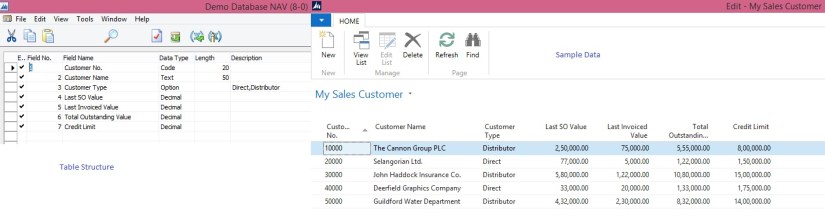
I have prepared a table with below fields and filled with some sample data.

DataUpgradeCU-1

Fill in the My Sales Customer table with demo data.

Make sure you have data in all columns, preferably create several records in this table.

Now when the fields are deleted from the My Sales Customer Table and the data is saved in the UPG My Sales Customer table, we will create the new table where the data will reside in the new version (My Detailed Customer Entry) and move that data into that table using Data Upgrade action in the Dev. Environment.

Since now my project requirement is to refactor the My Sales Customer table and delete the fields which store the information about the Sales Information (“Value” fields), we need to create an intermediate upgrade table where the data from those fields will be stored until you move it into the new My Detailed Customer Entry table.

We will perform below action:

  • Open the Object Designer and select table My Sales Customer
  • Select the Design button to open the table in the designer.
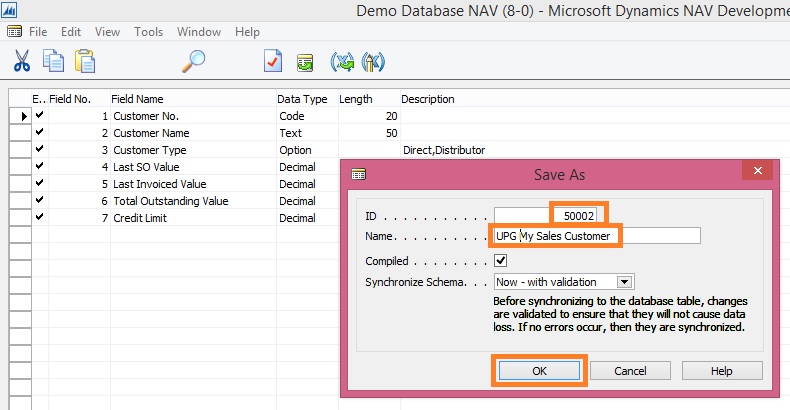
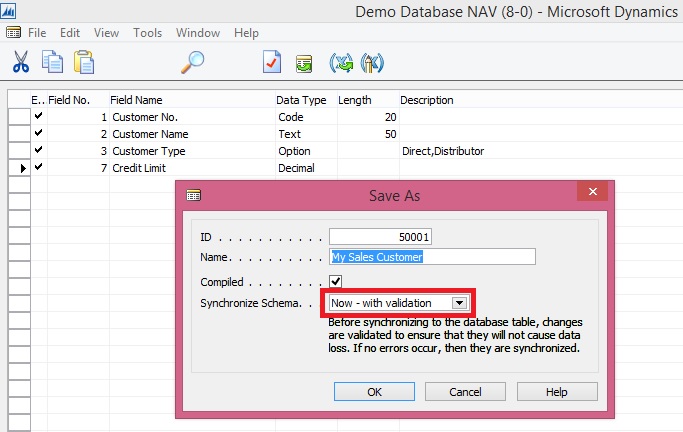
  • In the Dev. Environment menu, select File-Save As… action.
  • Change the ID value to New ID, change the Name to UPG My Sales Customer and select OK button to close the dialogue and create a copy of the table.

DataUpgradeCU-1

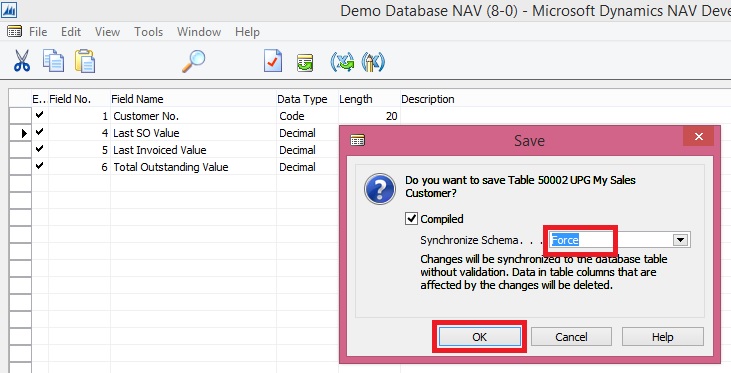
  • In table UPG My Sales Customer delete fields Customer Name, Customer Type and Credit Limit.
  • In the Dev. Environment menu, select File-Save action.
  • On the Save dialogue, set the Synchronize Schema option to “Force” and  select OK button to close the dialogue.

DataUpgradeCU-1

  • In the Object Designer select the Codeunits button and then click New to start creating a new upgrade codeunit.
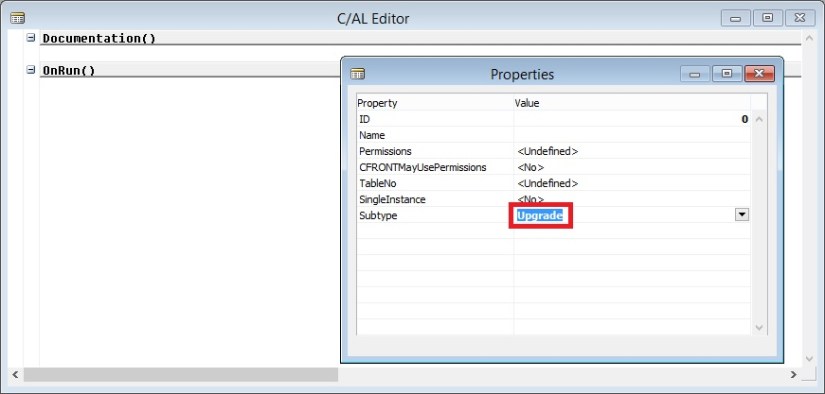
  • In the Dev. Environment menu, select View-Properties action to start editing the properties of the codeunit.
  • Change the Subtype property to Upgrade and close the Properties form.

DataUpgradeCU-1

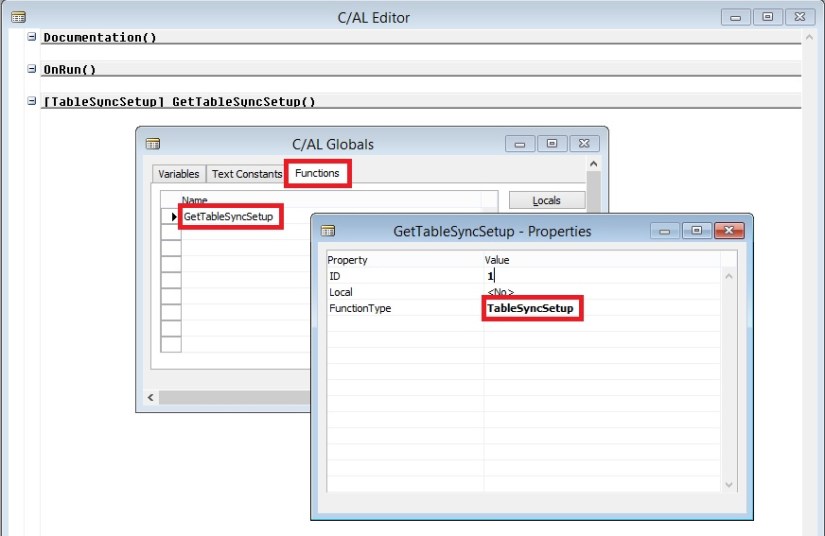
  • In the Dev. Environment menu, select View-C/AL Globals action and in the form which is opened select the Functions tab.
  • Enter the name of the function, e.g. GetTableSyncSetup
  • In the Dev. Environment menu, select View-Properties action to start editing the properties of the function.
  • Change the FunctionType property to TableSyncSetup and close the Properties form.

DataUpgradeCU-1

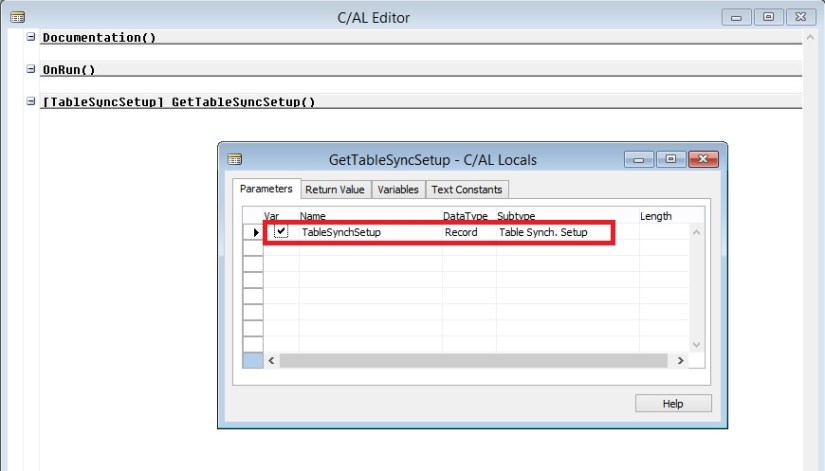
  • Select the GetTableSyncSetup function on the Functions tab and then select the Locals button to define function parameters.
  • Add a parameter of DataType = Record, Subtype = Table Synch. Setup, Name = TableSynchSetup, Var = Yes.

DataUpgradeCU-1

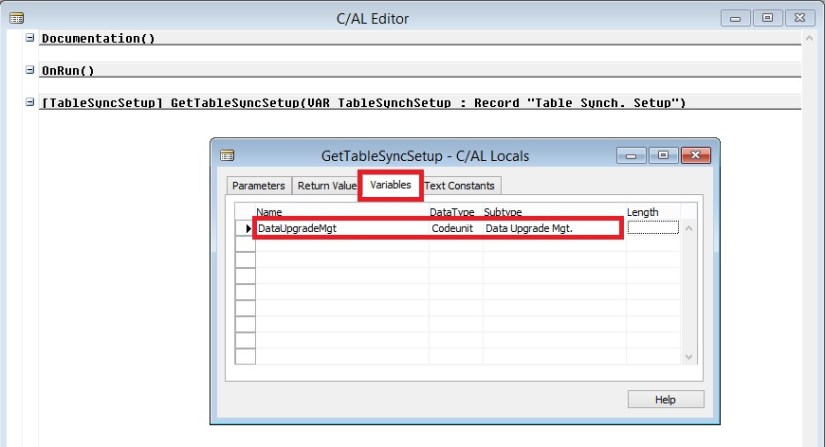
  • On the C/AL Locals form, select Variables tab and add a local variable of DataType = Codeunit, Subtype = Data Upgrade Mgt.
  • Close the C/AL Locals and C/AL Globals forms to return to the C/AL Editor.

DataUpgradeCU-1

  • In the GetTableSyncSetup function, add the C/AL statement as presented on the screenshot.
  • In the Dev. Environment menu, select File-Save action to save the codeunit.
  • On the Save dialogue, define ID , Name = UPGTK Codeunit, and select OK to save the codeunit.
  • Close the codeunit editor.

DataUpgradeCU-1

[

//>>Data Upgrade Code

// To copy data from table My Sales Customer to UPG My Sales Customer table

DataUpgradeMgt.SetTableSyncSetup

(

DATABASE::”My Sales Customer”,

50002,

TableSynchSetup.Mode::Copy

);

//<<Data Upgrade Code

]

  • In the Object Designer, select the Tables button and then select the My Sales Customer table in the list of tables.
  • Click Design to open the table in the table designer.
  • Delete the following fields:
  • Last SO Value
  • Last Invoiced Value
  • Total Outstanding Value
  • In the Dev. Environment menu, select File-Save action.
  • On the Save dialogue, notice that the Synchronize Schema option is set to “Now – with validation” and select OK button to close the dialogue.

DataUpgradeCU-1

  • In the Object designer, find table UPG My Sales Customer and click Run to check if the data was copied there by the schema synchronization.

DataUpgradeCU-1

Here we are now done with the Part -1 of our exercise. Next step is to move this temp data in respective table as part of our Upgrade. We will see upgrade part in our next post.

Development Tips

Schema Synchronization in Microsoft Dynamics Navision 2015

NAV 2015 provides you with flexibility of deciding when and how your table changes should be synchronized with corresponding SQL tables.

What is table synchronization?

SchemaSync-1

NAV 2013 R2:- Schema synchronization executes automatically on any connection to the Server.

NAV 2015:- Schema synchronization executes on demand by the Server.

Way the Synchronization works:

  1. Per Table Synchronization
  2. Synchronizing schema changes for all tables

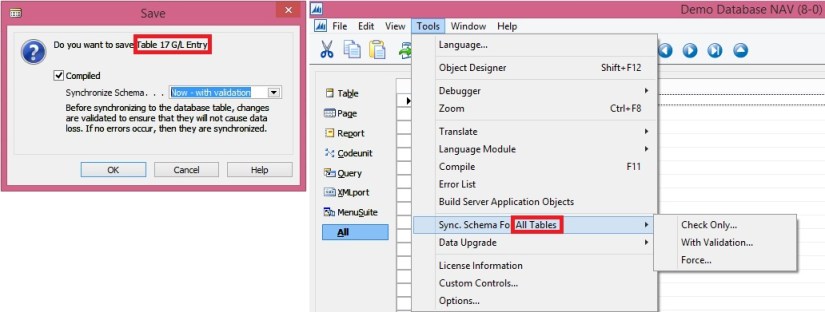
SchemaSync-2

Now let us see how it works:

SchemaSync-3

Add/Modify/Delete Fields (change table definition) we will be prompted for Synchronizing the Schema.

It gives three options description is self-explanatory.

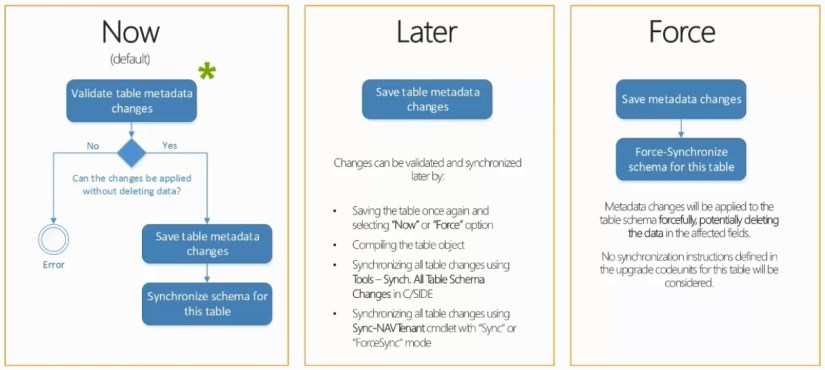
Some time we have to do major changes to the tables which takes lots of time to sync, we can postpone the sync process by selecting Later. Once we are done with all of our changes we can go with synchronization in one go.

SchemaSync-4

We get same options.

New option Check Only….

SchemaSync-5

This option will only report outcome and will not Sync the Schema.

Since we have just added new field so no risk as reported by above check.

Now I will delete one field from the table and let’s see what result comes.

SchemaSync-6

Summary of the 3 options as below:

SchemaSync-7

When data loss is reported while changes in table definition is referred as destructive changes.

SchemaSync-8

You use upgrade codeunits when you make changes to a table definition, either from the Microsoft Dynamics NAV Development Environment or during an upgrade. Upgrade codeunits migrate existing business data from the old table structure into the new table structure. An upgrade codeunit serves the following purposes:

  • Provides instructions for how to handle data changes to a table during schema synchronization.
  • Provides the logic for migrating existing data in the business data table from the old format to the new format after schema synchronization.

A typical example of when to use an upgrade codeunit is when you remove a field from a table definition and you do not want to lose the existing data in the business data table. Instead, you want to use it somewhere else in the new application.

You implement upgrade codeunits when you make destructive changes to tables in Microsoft Dynamics NAV Development Environment. After you have created an upgrade codeunit to handle table changes, you can use it when you upgrade data from an earlier version of Microsoft Dynamics NAV to the current version. A single upgrade codeunit will typically contain table schema synchronization instructions and data migration logic for multiple tables that have changed from one version of Microsoft Dynamics NAV to another.

SchemaSync-9

I will come back on this topic in another post with more details.

And many more options like PowerShell Sync with above options.

Benefits:-

Perform on demand – transparency -> As developer and system administrator, you are in control when to call the schema synchronization and how to synchronize table changes. You can invoke it, plan for it and schedule for it on a case by case basis. You can also monitor its progress and monitor the state of your database (tenant).

Not blocking other changes – productivity -> Schema Synchronization has become more granular. It can be performed per table object as well as for all table changes at once. When one table is being synchronized you are no longer blocked, and you can continue making changes to other tables.

Opened for additional instructions – flexibility -> Using upgrade codeunits you can provide input for the schema synchronization to do extra tasks, like automatically moving or copying data into upgrade tables, checking the changes or forcefully applying them where necessary. (Will come up with more details on this in my next post)

Report

Creating Custom Word Layout for Document Reports in Navision 2015

Open the MS Office Word.

File -> New and type Invoice in search and press enter to list available Invoice Templates.

Document Reports -1

In my example I am using [Sales Invoice (Blue Border Design)]

Document Reports -2

Select Create to download the template and create a document for you.

Your new document created from this template will look as below:

Document Reports -3

Prepare the Layout by removing extralines as we will be using repeating lines for Lines.

Save your Template.

I have made a copy of Report 206 – Sales – Invoice on new ID say (50005 as Sales – Invoice Word).

This report dosen’t have Word Layout. We will be creating one Customize Layout form above saved Invoice above. [Sales Invoice (Blue Border Design)]

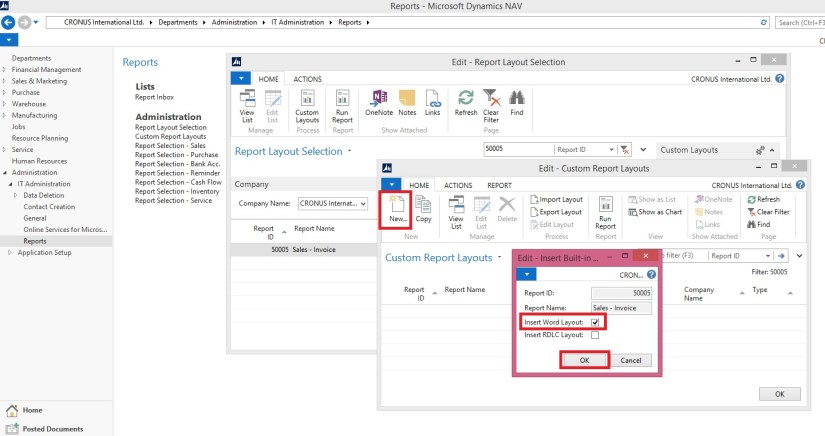
Open Report Layout as shown in below Screen:

Document Reports -4

Document Reports -5

Slect the Report and choose Custom Layout as shown in above screen.

Document Reports -6

In Custom Report Layout Window Click on New.

From window Insert Build-in Layout for Report Select Insert Window Layout and click OK button.

Document Reports -7

From Custom Report Layout window Select Import Layout, Select your word file prepared above and Respond Open to Import.

Document Reports -8

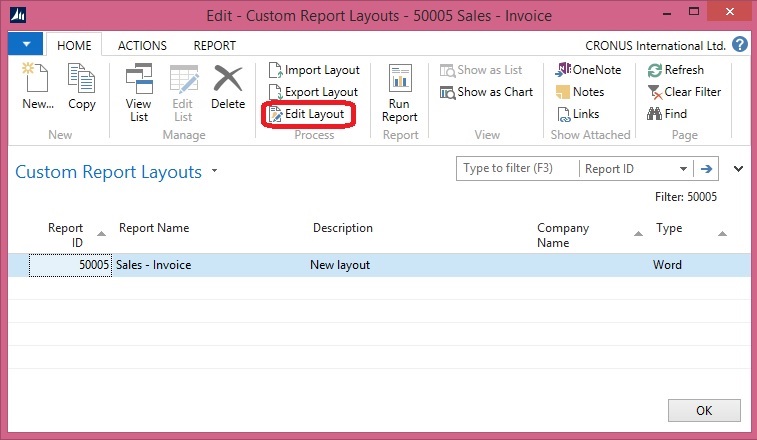
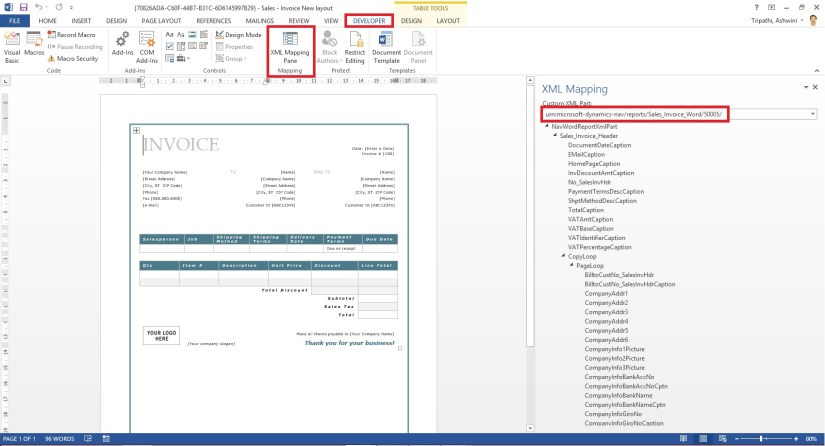
Then, press Edit Layout and prepare layout on Developer tab, find XML Mapping Pane and find your document in Custom XML Part.

Now, you can find all fields from Dataset.

Document Reports -9

Please see below links to complete your report:

Adding image fields

Add fields from a report dataset to a word report layout

Creating my first word list report in Navision 2015

How to specify the default built in report layout

Create a word report layout for a report

Once you are done with your field assignment close the word layout.

Document Reports -10

Select Yes to import changes to the report.

Document Reports -11

Select Run Report to view the output of your report.

Now you are done with your Custom Report Layout.

Please see sections which will be more helpful to complete your task:

Reports

Uncategorized

Useful Tips for Technical as well as Functional (Saving Customer/Vendor/Item as Template)

Normally we see Template is created at on Interface and the Customer/Vendor/Item are created via other interface.

We can make it more user friendly, in below article I will show some readymade tips available in Navision It is available in 2013 and 2015, for lover version please verify accordingly.

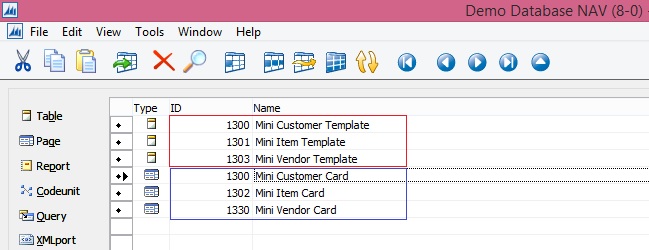
First Lets have a look at what all is available to us then we will see how we can make the more meaningful to our customers. Obviously if any out of box customization is required that we have to carry out.

Template-CVI-1

Others too available check it out, I will show one of them rest you apply same skill to accomplish others.

Let’s Start with Page 1300 Mini Customer Card what it looks like.

Template-CVI-2

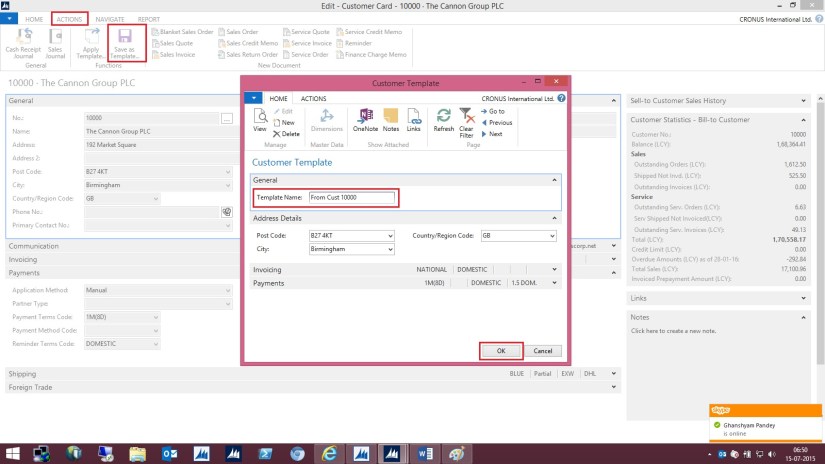
In this Page on Action Tab we have Save as Template the functionality which we are going to use in our Article for today.

Template-CVI-3

Let’s First Link this Page (1300) with our Std. Customer Card Page (21).

I will Add New Action on my Page and set following Properties.

Open the Page 21 in Design Mode & Access View -> Page Actions.

Template-CVI-4

We have added this Link Just for information you can Skip this step, it is not compulsory for what we are going to perform below in next step.

Here other tabs of Mini Customer Card is only visible following certain Conditions. So nothing wrong with code or design. Technical can review the code and find out the reason for same.

Like :

Template-CVI-5

Template-CVI-6

Next we will copy one Functionality from Page 1300 to our Page 21. Save as Template.

Open the Page 1300 in Designer and access to View -> Page Actions.

Template-CVI-7

Save the object no further any coding or Variable definition will be required. As this Functionality is properly designed as plug and Play. Required Variables are defined local and it takes the Current Record as Parameter.

TempMiniCustomerTemplate.SaveAsTemplate(Rec);

Now Open your customer card, scroll to record which you want to save as Template and Select Save as Template from Action Tab. Give the Template name to save and click OK.

Template-CVI-8

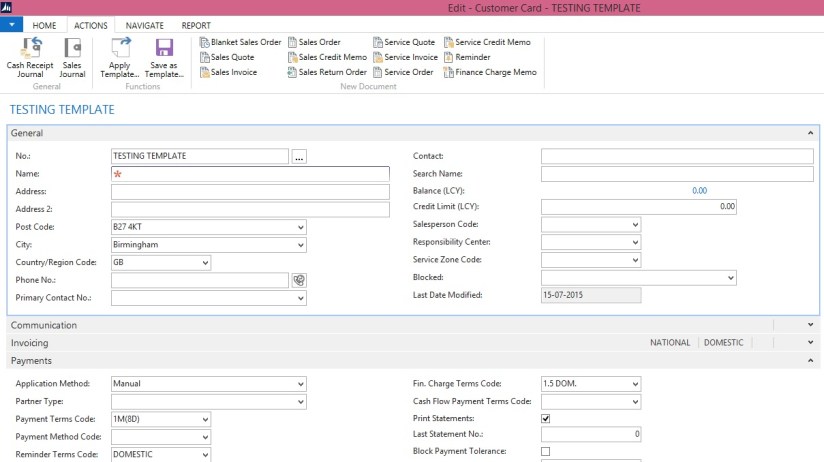
Your Template is saved. Now you can use the same to apply to your New Customer.

Now Create New Customer and Select Template to Apply.

Template-CVI-9

Template-CVI-10

You are done.

This way you are able to give something new to your Customer without any major customization.

Similarly you can do for Item & Customer too.

Explore there are few more which will be helpful in certain conditions.

Office Integration

Integrating with Microsoft OneNote With Navision 2015

You can set up Microsoft Dynamics NAV to work with Microsoft OneNote.

For example, you can use OneNote integration to synchronize notes from a mobile OneNote installation with Microsoft Dynamics NAV. You can also use OneNote to share pictures, recordings, and other instructions across a company.

When you set up OneNote integration, you can enable adding notes to a particular record or to a complete page

Note: You cannot set up Microsoft Dynamics NAV to work with OneNote in multitenant deployments.

With Microsoft OneNote integration you can attach notes to customers, items, or invoices.

OneNote notes can be created for a specific record, but also for a whole page depending on the setup.

You can attach notes, reminders, or pictures to a specific record such as a customer. You can also create a note attached to a whole page, so there are separate instructions about how to deal with customers, items, or journals.

Pages notes can only be used on pages that are based on a source table. This means that, for example, the Role Center page cannot use page notes.

Note: OneNote integration lets users share their OneNote repository, which means that information in a shared OneNote repository can be read by all persons having access to that repository.

Let’s start with creating background which we will use in Setting up our solution, I am using   Local folders to configure my OneNote.

OneNote-1

Here I have created two Folders

  1. PageNotes
  2. RecordNotes

How to access PageNote & RecordNote.

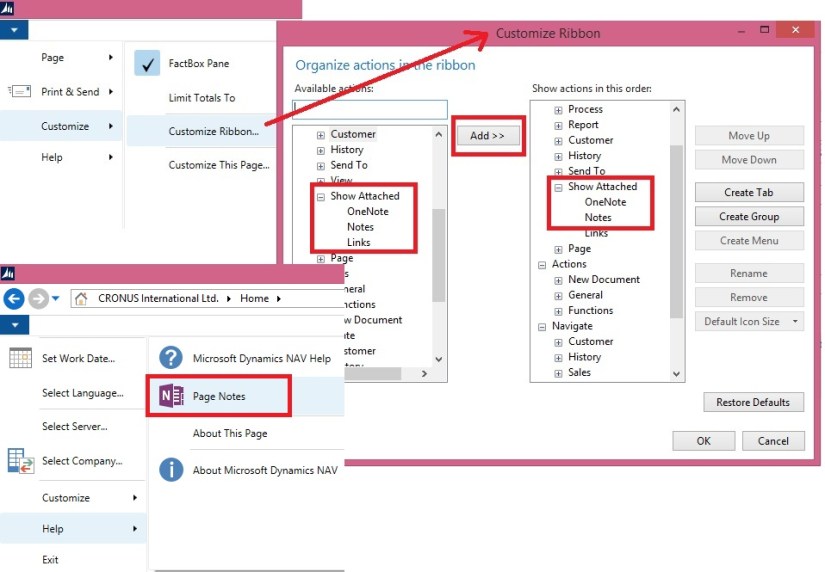
If OneNote not visible on Pages you can add the same as below:

OneNote-3

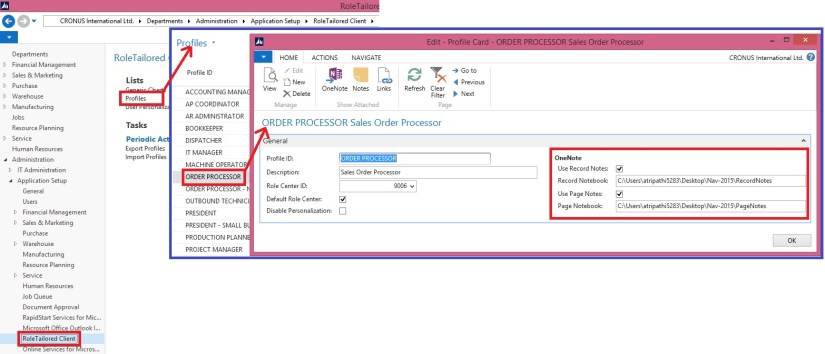
To set up OneNote integration for a group of users

  1. In the Search box, enter Profiles, and then choose the related link.
  2. Select the profile to make the OneNote adjustments for.
  3. On the Home tab, choose Edit.
  4. Select the Use Record Notes check box.
  5. In the Record Notebook field, enter the path where Microsoft Dynamics NAV should access the notebook.

OneNote-2

Note: You can find this information in Microsoft OneNote using the File tab. Select the OneNote book that you want to use, this can be shared among the books listed in Notebook Information or you can create a new one. Copy the location path for the notebook.

You may want to use customization to promote the OneNote action to the ribbon for easy accessibility.

If want to us Page Note too follow below steps:

  1. Select the Use Pages Notes check box.
  2. In the Page Notebook field, enter the path where Microsoft Dynamics NAV should access the notebook.
  3. Choose the OK

Note: The RoleTailored client must be restarted for the changes to have effect.

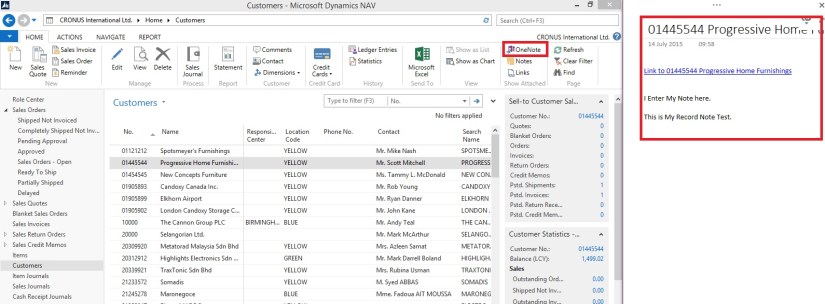
Using Record Notes

  1. From any Page Select OneNote, Note For selected record will be available to record.

OneNote-4

Your One Note File is created in the specified Folder:

OneNote-5

Accessing the Record Notes:

OneNote-6

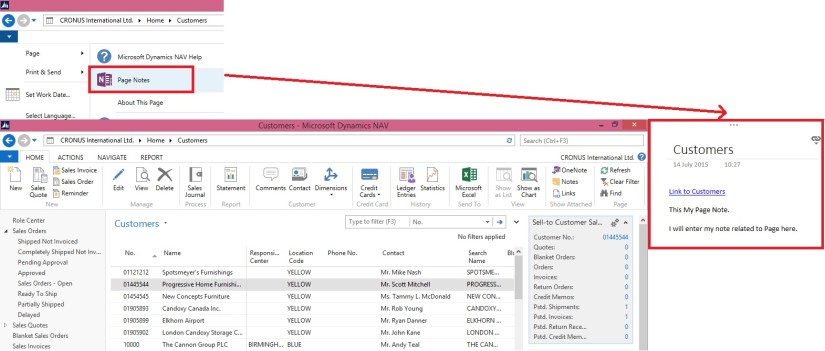
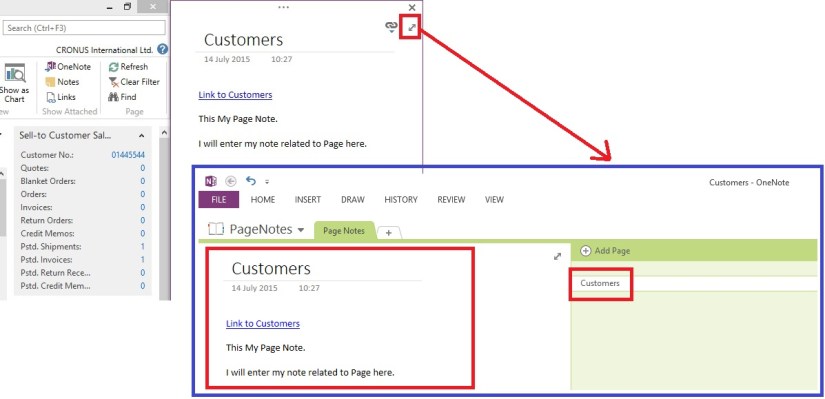
Using Page Notes

  1. From any Page Select PageNote, Note For active Page will be available to page.

OneNote-7

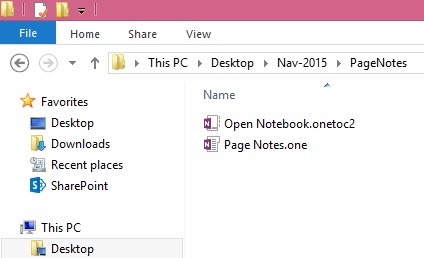
Your Page Note File is created in Specified folder

OneNote-8

Accessing the Page Note

OneNote-9

Try using it, it’s Simple and Very useful.

Report

The New Report Scheduling feature for end users running reports in Microsoft Dynamics Navision 2015


The new Report Scheduling feature for end users running reports:

  • End user can schedule reports for later execution.
  • User can get to his next task quicker.
  • User has an inbox part for viewing the scheduled reports.

 A. Setting up the job queue to run a report

My Customer needs to run a number of long running reports and does not want to wait for them to complete.

The scenario is simplified because a typical customer setup would involve setting up a NAS instance to process the reports.

* Open the Job Queues page.

ReportSchedule-1

* On the Home tab, in the New group, choose New to set up a new job queue

ReportSchedule-2

* In the Code field, type Reports.

* Fill in the Description field My Report Schedule.

* Leave the Job Queue Category Filter field blank.

* On the Home tab, in the Process group, choose Start Job Queue.

* Close the Job Queue Card

ReportSchedule-3

A job queue with no filter runs the reports.

In many customer installations, the reports will be picked up by the DEFAULT job queue


B. Adding the Report Inbox to the Role Center

My Customer wants easy access to the reports that he has scheduled, so he adds the Report Inbox part to the Role Center page.

* To open the Role Center page that you want to customize, in the navigation pane, choose the Home button, then choose the Role Center menu item.

* On the Application menu , choose Customize, and then Customize This Page.

* In the Available Parts pane, select Report Inbox, and then choose the Add button.

* To move the Report Inbox part to top of the second column in the Role Center layout pane, select it and then use the Move buttons.

* (Optional) To add the My Job Queue to the Role Center, in the Available Parts pane, select My Job Queue, and then choose the Add button.

* (Optional) To move the My Job Queue part below the Report Inbox in the Role Center layout pane, select it and then use the Move buttons.

ReportSchedule-4

ReportSchedule-5

* Verify that the Report Inbox appears in the Role Center.

ReportSchedule-6


C.Scheduling a report and viewing the result

* On the Role Center, on the Report tab, choose Customer Order – Summary.

* On the report request window, choose the Print button, and then choose Schedule

ReportSchedule-7

* In the Schedule a Report window that appears, in the Description field type a different text.

* In the Report Output Type field, select the down arrow, and choose PDF.

* Choose the OK button.

ReportSchedule-8

* Go to the Report Inbox on the Role Center and show that the report appears when it is finished running.

* To view the report, select it in the Report Inbox, and then choose Show.

ReportSchedule-9


D. When a scheduled report fails

* Open the Role Center.

* On the Application menu , choose Customize, and then Customize This Page.

* In the Available Parts pane, select My Job Queue, and then choose the Add button.

* To move the My Job Queue part below the Report Inbox in the Role Center layout pane, select it and then use the Move buttons

* In the Role Center, go to the My Job Queue part.

We have already done above step in above steps. Let’s continue with next step. If not already done follow the steps as defined above.

* On the Role Center, on the Reports tab, choose Price List.

* In the Sales Type field select Customer.

* To schedule the report to run later, choose the Print button, then select Schedule.

* In the Schedule a Report window, leave the default values in fields and choose the OK button.

ReportSchedule-10

* When the error shows up in the My Job Queue part, select the error, and then choose Show Error.

* Read the error message, and then choose the OK button to close it.

ReportSchedule-11

* Open the Job Queue Log Entries page.

* Filter the list to display entries whose Status is Error.

* To view the error message, point to the Error message field for the entry, or, select the entry, and then on the Home tab, choose Show Error Message.

* Return to the Role Center, and then run the Price List report again.

* On the report request window, set the Sales Type field to All Customers, choose Print, and then choose Schedule.

* In the Schedule a Report window, leave the default values in fields and choose the OK button.

* In the Report Inbox on the Role Center, view the completed report.

ReportSchedule-12


Cumulative Updates

List of Cumulative Updates for Microsoft Dynamics NAV 2015 as of July 2015

Knowledge Base ID Title Release date Build no. Local versions included
3075726  (https://support.microsoft.com/kb/3075726/ ) Cumulative Update 9 for Microsoft Dynamics NAV 2015 July, 2015 41779 AT, AU, BE, CH, CZ, DE, DK, ES, FI, FR, IS, IT, NA, NL, NO, NZ, RU, SE, UK
3069272  (https://support.microsoft.com/kb/3069272/ ) Cumulative Update 8 for Microsoft Dynamics NAV 2015 June, 2015 41370 AT, AU, BE, CH, CZ, DE, DK, ES, FI, FR, IS, IT, NA, NL, NO, NZ, RU, SE, UK
3058000  (https://support.microsoft.com/kb/3058000/ ) Cumulative Update 7 for Microsoft Dynamics NAV 2015 May, 2015 40938 AT, AU, BE, CH, CZ, DE, DK, ES, FI, FR, IS, IT, NA, NL, NO, NZ, RU, SE, UK
3052226  (https://support.microsoft.com/kb/3052226/ ) Cumulative Update 6 for Microsoft Dynamics NAV 2015 April, 2015 40459 AT, AU, BE, CH, CZ, DE, DK, ES, FI, FR, IS, IT, NA, NL, NO, NZ, RU, SE, UK
3039824  (https://support.microsoft.com/kb/3039824/ ) Cumulative Update 5 for Microsoft Dynamics NAV 2015 March, 2015 40262 AT, AU, BE, CH, CZ, DE, DK, ES, FI, FR, IS, IT, NA, NL, NO, NZ, RU, SE, UK
3035986  (https://support.microsoft.com/kb/3035986/ ) Cumulative Update 4 for Microsoft Dynamics NAV 2015 February, 2015 39663 AT, AU, BE, CH, CZ, DE, DK, ES, FI, FR, IS, IT, NA, NL, NO, NZ, RU, SE, UK
3024901  (https://support.microsoft.com/kb/3024901/ ) Cumulative Update 3 for Microsoft Dynamics NAV 2015 January, 2015 39368 AT, AU, BE, CH, CZ, DE, DK, ES, FI, FR, IS, IT, NA, NL, NO, NZ, RU, SE, UK
3020885  (https://support.microsoft.com/kb/3020885/ ) Cumulative Update 2 for Microsoft Dynamics NAV 2015 December, 2014 38798 AT, AU, BE, CH, DE, DK, ES, FI, FR, IS, IT, NA, NL, NO, NZ, RU, SE, UK
3013215  (https://support.microsoft.com/kb/3013215/ ) Cumulative Update 1 for Microsoft Dynamics NAV 2015 November, 2014 38457 AT, AU, BE, CH, DE, DK, ES, FI, FR, IS, IT, NA, NL, NO, NZ, RU, SE, UK